Showing posts with label toulmin. Show all posts

Monday, June 18, 2012

Negative Ads – Mapping Arguments


Having looked at one of Governor Romney’s negative ads in our last entry, in the interest of fairness it’s time to review a negative ad produced by the Obama campaign targeting his presumed Republican rival. 

In this instance, we’re looking at this TV ad which is was designed to portray Romney, who served as the CEO of the large private equity firm Bain Capital, as being responsible for the closing of the century-old CST steel mill with the result of numerous lost jobs and ruined lives. 

Others have discussed the effectiveness of the ad, and we could certainly analyze it in terms of its use of pathos to lead viewers towards a specific conclusion (specifically, the ads use of moving emotional testimony from people affected by the plant shut down and powerful images of a ruined landscape where a thriving enterprise once stood – illustrating both the theme of devastation and hinting at what the American landscape might look like if the Republican candidate is elected).

But today we are continuing our look at argumentation and, as mentioned previously, negative ads – for all their manipulativeness – must be premised on some kind of logical argument (as opposed to positive ads that can rely just on warm and fuzzy pathos).  And if we can figure out what argument a negative ad is making, we can use that understanding to determine our next steps towards drawing our own informed conclusions.

This time, we are going to make use of the Toulin method for diagramming arguments that I mentioned in a previous post.  It’s worth reading that original piece over to understand how Toulmin breaks arguments down into Grounds (evidence) leading to a Claim (a conclusion) with a Warrant providing the support that links Grounds to Claims.  (We’re going to keep this example simple by skipping over Backing for now.)

The Bain ad actually starts with a simple argument that can be presented in Toulin fashion as:


By breaking the argument into these linked components, it becomes easier to determine which elements can be supported or challenged.  For example, the Grounds cannot be challenged on the basis of fact since Bain was indeed the owner of the firm during its slide towards bankruptcy. 

On one level, Mitt Romney’s role in the firm (the Warrant) also looks like a statement of fact, but this is deceptive.  Like many complex real-world situations, not all truths resemble “All Cats are Animals” with regard to judging truth or falsehood.  For example, one could look at the timing of decisions related to CST and map them to the timing of Governor Romney’s changing roles within the organization (which take into account his leaves of absence when running the Salt Lake City Olympics in 2002 or running for the Presidency in 2008).  One could also challenge whether Romney’s role in a large organization such as Bain was directly responsible for the mill being shut down.  In both cases, you would be challenging whether the Warrant is sufficient to support the Claim (that Romney is responsible for the shutdown of the mill) regardless of the accuracy of the Grounds.

It’s at this point that the Warrant ends up turning into a Claim to another argument which expands our Toulin diagram to look like this:


Again, one can challenge the Claim and/or Warrant of this new argument (digging further into the reasoning behind certain decisions, for example) or questioning the responsibility of the CEO for the consequences – expected or unexpected – of every decision.  But putting aside details of how such challenges might be made, you can begin to see how mapping the logical argument hidden within the original seemingly emotion-driven negative ad gives us something substantial to discuss when either supporting or challenging its fundamental call to action.

And what is that call to action?  Well if we expand our Toulin map to include the critical hidden argument that sits on top of the entire persuasive effort, it would look like this:


While it took a little work to tease out the argument underlying the Obama ad, now that we’ve done so we have a number of ways to explore or challenge the entire argument, with research from news sources like this one being useful to help us accept or reject certain Grounds, Claims and Warrants.

For those who feel negative ads to be unpleasant or manipulative, the effort needed to turn them into a coherent logical argument (leveraging tools like Toulmin to make sure such arguments take into account more than Aristotelian syllogisms can) helps us do something the makers of such ads would prefer we don’t do: think for ourselves.  

Wednesday, January 25, 2012

Logic – 2


What do these two examples of syllogistic-style arguments have in common?

Husband: Honey, our children are hungry.  Feeding them your meatloaf would eliminate their hunger. Therefore, you should cook meatloaf.

Wife: But, honey, your second premise is faulty.  For feeding them your lasagna would also eliminate their hunger.  Therefore, you should cook tonight.

Candidate 1: Programs to help the poor are meant to decrease poverty.  But there is more poverty today than there was before these programs began.  Therefore, programs designed to fight poverty actually acccomplish the opposite.

Candidate 2: Your argument proposes a single cause for poverty.  But there might be many causes for poverty.  Thus, your argument is invalid. 

First off, both arguments consist of properly constructed syllogisms, and both are countered with effective challenges based on classic principles of logic.  Second off, they both sound completely idiotic since no human being in their right mind would actually talks this way.

These examples highlight one of the challenges with traditional logic which is designed to create a language and framework into which any argument (sound or unsound, based on reality or fantasy) can be fit.  And while it’s all well and good to know that the argument “All mermaids are female.  Gwen is a female. Therefore Gwen is a mermaid.” is fallacious (regardless of whether or not mermaids exist); here on earth mermaids don’t exist (as far as we know).  More importantly, people talk to and argue with each other using actual human language that can lose its persuasive power (not to mention its ethical underpinning) when it is boiled down to symbols and straight jacketed into “proper” logical syntax.

Now one can make the case that even the most complex arguments presented in the floweriest of language can be reworked into logical structures, and that these structures are a better basis of analysis than the original text.  But might there be a way to take a look at the actual conversations real people have with each other and place them into a framework that lets us look at them in context, without having to boil everything we say down to the question of whether A equals NOT A?

I mentioned that many new logical systems have been developed over the years and while some of them are mathematically complex and best suited for specific purposes (like the creation of computer software), some wrestle with the need to build a rigorous structure around arguments without turning interesting prose into quasi-mathematical symbols which might eliminate value found in the subtlety of the original language.

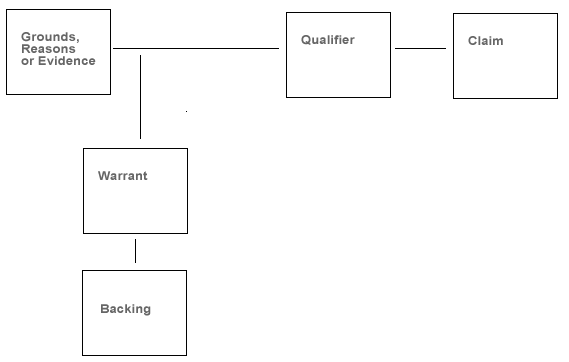
My favorite attempt to create this type of structure is the ToulminModel (developed by the British Philosophy Professor Stephen Toulmin) which proposes the existence of practical or substantial arguments (wonder why I like him?) that can be diagramed in the following manner:


In this model, the Claim is an assertion you are trying to prove, the Grounds consist of the information you bring to prove the claim and the Warrant supports your assertion that the Grounds should lead you to the Claim.

“What’s the big deal!” I hear you cry out.  Isn’t a “Claim” just a conclusion to a logical argument?  And aren’t “Grounds” just another way of describing your premises, with logic serving the role of the “Warrant” that links the two?

Actually, no, since Grounds in the case of a Toulmin argument might consist of facts (even axiomatic facts that logic requires everyone to agree to as the basis of any argument).  But they might be laws, regulations, social customers, literary references, or any other man-made (or even natural) “thing” that can provide support for the Claim. And the Warrant can make a logical connection, but it might also make an emotional or ethical appeal (all equally valid under Toulmin’s scheme).  And the fact that the Warrant requires Backing (a demonstration that the Warrant is sound and appropriate) adds an additional layer of rigor, even if this Warrant relies primarily on logic to link A (Grounds) to B (a Claim).

Toulmin also adds another nice feature: the Qualifier, that lets you present exceptions to your Claim. While qualifications can be implied in logical statements such as SOME As are NOT B, natural language cries out for us to specify which As we are talking about.  So the claim that “Freedom of speech is an unarguable good.” can be easily qualified as “Freedom of speech is an unarguable good, except in cases where it might lead to physical harm to someone else.” without diminishing the original point (or leaving us responding to an seemingly logical but actually illogical argument that “Since you don’t believe in free speech in all situations, you don’t really believe in free speech).”

Now Toulmin diagrams can get quite complex, especially once you realize that Grounds may be required to support a Warrant and that this means the Warrant can play a secondary role as another Claim (or Sub-Claim) that needs to be supported (with Grounds, Warrants and Backing) before it can be accepted and used to prove the ultimate Claim.

This might all sound a bit abstract, but as we’ll see once we start digging into actual political debates (i.e., arguments) Toulmin provides an important arrow in our quiver as we try think about the best way to think for ourselves during a Presidential election when many people would prefer that we not think at all.