Sunday, March 18, 2012

Nudge Nudge


Finishing up the discussion of Kahneman’s Thinking Fast and Slow on a cautionary note, the book’s model of a human mind broken into two parts: a fast, associative System 1 that does the bulk of our day-to-day cognitive work and a slower, deliberative System 2 that analyzes deeply, handles counter-intuitive situations, and takes control when necessary should be seen for what it is: a metaphor.

The author himself announces the metaphorical nature of his construct of the mind, telling us early on that his creation of the labels System 1 and System 2 was a deliberate artifice which, among other things, provides his alleged System 1 some named characters for one of the stories it uses to achieve understanding.  And as much as the metaphor of slow and fast mental entities working in partnership helps explain a wide number of observable phenomena (such as our tendency to fall for visual and cognitive illusions), we shouldn’t lose sight of the fact that Kahneman’s is just one of a long line of metaphors used to describe human behavior.

For example, while it has become fashionable to sneer at Freud, his identification of a conscious and unconscious mind (not to mention the Ego, Superhero and Id he posited) not only impacted both the scientific and wider culture, it also served as the foundation for modern public relations and advertising when put to practical use by Freud’s nephew Edward Bernays.  And our culture’s fondness for the notion of a Left-Right creative-logical split in our brain (despite an absence of physical evidence for such a divide) simply proves how much we humans desire to break our world into neatly labeled categories.

Now it may very well turn out that Kahneman’s fast/slow dichotomy will withstand experimental scrutiny over time.  But work done since then (including a colleague’s thesis I’m currently reading that proposes three different modes of thinking vs. Kahneman’s measly two) is already building on and refining the original hypothesis.  So before we start abandoning previous theories and models and start thinking of ourselves entirely in fast and slow terms, it’s best to exercise some humility and accept the fact that this model, while useful, may very well turn out to be wrong.

Shifting gears to political matters (which is supposed to be the subject of this blog), I must also admit to becoming uncomfortable when the author began suggesting examples of his theories could be put to practical advantage. 

If our minds work a certain way, the author asserts, why not take advantage of this phenomenon to gently move (or nudge) people towards socially acceptable or preferable behavior?

The classic example of this idea comes out of the near 100% volunteer rate for organ donation in certain European countries, vs. a far smaller rate for Americans.  This difference turns out not to be the result of differing levels of generosity between cultures, but rather a different in forms – specifically organ-donation volunteer forms which are opt-out abroad (meaning volunteering for organ donation is the default choice) but opt-in here in the US.  So if telling your printer or web page designer to change which box is checked automatically can lead to such a huge increase in some socially beneficial good, why not apply it to other societal problems (such as improving American saving habits by making joining an automatic savings plan the default option)?

The trouble is that you pretty rapidly run out of examples of causes where playing on global cognitive hard wiring will lead to unquestionably good outcomes.  Kahneman highlights the popularity of Richard Thaler and Cass Sunstein’s recent book Nudge which shows how slight manipulations in how information is presented can gently push people towards making the right choices about their money, health and overall happiness.  And he’s particularly excited that one of the book’s authors is playing a role in the current US administration, providing an avenue to put these ideas into practice.

But who gets to decide what behaviors the population will be nudged into?  And who gets to determine where friendly nudging ends and outright manipulation begins? Historically, powerful persuasive techniques such as classical rhetoric or Freudian science have been embraced by politicians and advertisers who want to get us to do what they want.  So what is to prevent new techniques based on what we think we know about our fast and slow processors from simply becoming the friendliest option on a list that also includes propaganda and coercion?

It may be a fool’s errand, but if this blog is about anything it’s about trying to engage that reasoning part of our minds (or our slow processor if you like) much more than often we do when it comes time to make key decisions that can affect our future as individuals and as a country.  And while it would be far simpler if we could all be made to “do the right thing” by simply switching around some wording or some options on a form, fears over who gets to be the nudger makes the far messier option of trying to get people to think for themselves a preferable alternative.

Friday, March 9, 2012

Slow Down


Continuing with the discussion of Daniel Kahneman’s Thinking Fast andSlow, I noted that the author’s construct of a brain separated into a fast, associative processor (System 1) informing but, occasionally, overridden by a powerful but lazy slow processor (System 2) helps explain a number of observable phenomena such as our susceptibility to visual and cognitive illusions.

This model can also help us understand pan-human tendencies towards certain types of cognitive biases, notably confirmation bias which makes us readily accept information that already conforms to our beliefs, but treats information that contradicts or confounds those beliefs with suspicion.  After all, if our fast associative System 1 uses stories to categorize and understand information coming at us from all directions, what makes more sense than to create a story that plays up our preferences and plays down or rejects our dislikes? 

Making room in our mind for uncomfortable facts takes effort, often involving looking at the world outside the framework of an easy-to-understand storyline and delving into uncertainties (or probabilities) which bring us into the realm of System 2.  Our slow processor does this work well, but engaging this lazy workhorse requires effort.  And if we can get along just fine believing a comfortable story about, say, our preferred presidential candidate representing all goodness and truth (while his opponent is a dishonest cad), why not simply accept fast System 1’s take on the matter and let slow System 2 enjoy the day off?

Kahneman’s discussion of psychology and behavioral economics can also inform other challenges that come into play during a presidential campaign, such as anchoring and framing. 

Anchoring involves putting out some information (usually numeric) that our mind automatically makes the starting point for further thinking about an issue.  An example the author uses is that if I ask a group of people if Gandhi was 140 years old when he died, all of them will, of course, answer no.  But if I then ask him how old they think he was when he died, they will tend to pick a significantly higher number than a group who was first asked an equally ridiculous anchoring question of whether the Indian leader died at age 9. 

Anchoring is a powerful phenomenon which takes advantage of a System 1 that grabs the first information it receives and uses it to build out a story that is harder to edit or delete than to create.  And thus we stick to first impressions, even if those first impressions are wrong or were purposefully implanted in the conversation to anchor us.  This is why politicians and advertisers (whether communicating employment statistics or quantitative health information regarding food products) want to get their numbers entered into the conversation early, so that subsequent conversations will stay anchored where they prefer.

Fast and Slow also draws attention to our dramatic preference for frames of reference that highlight gains vs. losses.  For example, many people who would buy a five dollar lottery ticket for a 1:10 chance to win $100 would refuse a bet that offered them a 10% chance of winning $100 but a 90% chance of losing $5.  Even though the two bets are nearly identical in economic terms (actually, once you do the math the second is better than the first), in psychological terms the notion of paying $5 for a lottery ticket is treated far more positively than losing $5 as the outcome of a failed bet.

Keep this in mind during the campaign season when candidates explain that they want to help you keep four-fifths of you money (rather than tax you at 20%) or perform what you suspect might represent some mathematical slight of hand.  In fact, whenever you are confronted by statistical data (from political friend or foe), it might make sense to stop what you’re doing, spend five minutes doing multiplication of various two-digit numbers in your head (which tends to engage System 2), and then come back issue afresh.

While I suspect that follow up to the work of Kahnaman and the researchers which followed him will help us further understand other political phenomena (such as our preference for certain cadences and word choice reflected in the rules of rhetoric), I started to get uncomfortable with his final conclusions regarding how his discoveries could be applied in the real world – the subject of some final thoughts next time.

Saturday, March 3, 2012

Think Fast


Like many people interested in the subject of this blog, I’ve been reading and enjoying Daniel Kahneman’s best-selling book Thinking Fast and Slow.

Those of us who dabble in the subject of critical thinking tend to assume a classical understanding of the human makeup, one that sees people as essentially rational creatures.  And when reason fails us, we tend to blame this failure on emotion or some other component of our animal/non-reasoning self temporarily overwhelming the rationality that makes us us. 

Kahneman’s work in psychology (which won him Nobel Prize when applied to economics) contradicts (or at least confounds) these assumptions, demonstrating as it did that our reason might actually be faulty (or, at least, doesn’t work the way we think it does). 

Kahneman (in landmark work done with his colleague Amos Tversky) posited that our “mind” actually consists of two components: a fast-processing piece which he names System 1, and a slower, more deliberate part named (you guessed it) System 2.  And unlike other attempts to bifurcate or trifurcate the brain (into artistic vs. quantitative right and left hemispheres, or Freud’s Ego, Superego and Id), Kahneman’s fast System 1 and slow System 2 seems to provide a great deal of rigorous descriptive and predictive power. 

Under this framework, System 1 processes information (such as information coming in from the senses) lightning fast and attempts to make sense of it via associations and stories.  You can experience the uncontrolled associative nature of System 1 the next time you hear a familiar song and immediately (and without any deliberate effort) remember the last time you heard it, the first time you heard it, a dozen songs like it, and that great date when you danced to it in college.  Stories provide a way for System 1 to create coherence around sensory data and other input, without having to engage the more deliberate concentrative power of System 2.

And this System 2 is extremely powerful, grabbing control and overriding the association- and story-driven decisions of System 1 whenever it likes.  The trouble is, deliberative System 2 doesn’t like to do this very often since it is a lazy system that would prefer to take System 1 at its word whenever possible.

Times when this is not possible include situations when understanding requires a statistical vs. story-based understanding since System 1 doesn’t really “do” probabilities.  In fact, the illustration (and tool) Kahneman uses to illustrate the distinction between the two Systems are bets or gambles which make no sense from a purely utilitarian point of view, but are perfectly understandable once you see decisions on whether to take those bets being made by System 1 that doesn’t really get probability and a System 2 that would rather not bother if it didn’t have to.

Beyond statistics, this two-part model helps explain our susceptibility to visual and cognitive illusions, such as this famous example:


Looking at this image, most of us “know” that the two parallel lines are the same length, regardless of the fact that our own eyes registers the first longer than the second (a visual that is confirmed by System 1 acting on its own- which is what happens when children confront this illusion for the first time).  The reason we grownups “know” the lines are of equal length is that our System 2 is pulling in not visual imagery (which is what System 1 uses to process data), but data drawn from memory, i.e., the specific memory of having experienced this illusion previously as a child.  (In fact, my memory recalls not just this illusion, but the exact puzzle book where I saw it published –one which had an elaborate maze on the cover whose overall shape resembles a British toff wearing a bowler hat.)

This combination of a fast associative processor and slower, lazier deliberative processor leads to other types of illusions/errors, my favorite being the response you get when you ask people how many of each animal Moses  brought onto the ark.  This gag doesn’t work on the printed page, but when you ask someone the question out loud, most of them will confidently announce “two,” and only afterwards feel sheepish that they mistook Moses for Noah, the confusion arising because both names fall into the associative category “famous Biblical figures with long-O sounds in their names”.  (My favorite use of this trick came when I asked the Moses question of my neighbor, the local Episcopalian Minister, who began on a long exegesis regarding relevant chapters of Genesis before I stopped her and told her Moses never had an ark.)

But the slow processor, which must take over to perform certain tasks (such as multiplying two-digit numbers in your head) can also cause errors and omissions, one of the most famous illustrated in this observational assessment

Illusions aside, during the course of any given day, most of the mind’s work is performed by System 1 with System 2 intervening only when necessary.  Reading this piece, for example (no matter how engrossed you might be by it) is pretty much a System 1 activity, given that it consists of processing written information in a language you understand.  In fact, System 2 has only really been engaged during a small portion of the period when you were involved with this piece (when you were counting the basketball passes if you clicked on the link above).

All very intriguing, I hear you cry out.  But what does that have to do with critical thinking in general and critical thinking about the US election specifically?  Expect an answer to that question next time.

Monday, February 20, 2012

Rhetoric - 2


We started out by looking at a number of linguistic rhetorical techniques that cannot in and of themselves be considered good or bad (or, more specifically, informative vs. manipulative), especially since they are nothing more than the cost of entrance to any political discussion, argument or debate. 

Whether you are entering the political process to change the world or line your pockets, if you cannot frame your points in an interesting and engaging way, you will never get the attention of friend or foe.  So just as the ability to write well is the first step to becoming a famed novelist (or even an unknown but good one), writing and speaking in a way that engages an audience is not a moral choice but a necessity.

But there are other rhetorical techniques that require their users to make ethical decisions, sometimes difficult ones, because of the persuasive power of these techniques (regardless of the quality or sincerity of the content they are used to present).  To illustrate what I’m talking about, I’m going to focus on a set of rhetorical devices that deal with how one acknowledges opponents and their arguments. 

One rather infrequently used technique, called dirimens copulatio, simply involves mentioning opposing facts in your own arguments, not to counter them but to demonstrate the speaker’s awareness that two sides of an issue exist.  An example of this might include “In international politics, there are rarely right and wrong answers or black and white situations.  Which is why there are many legitimate criticisms of the choices my administration has had to make.”

A far more frequently used technique is procatalepsis, which also acknowledges an opponent’s position but does so in order to anticipate and counter it in advance.  Statement such as “My opponent claims that I have been too eager to engage in war when peaceful alternatives were available.  To which I would respond, what alternatives are open to us when the nation is attacked?” or “Critics will call my spending plans wasteful and irresponsible.  But who is acting irresponsibly, someone trying to move the economy forward or someone saying “No” to every proposal to put people back to work?” are both examples of procatalepsis

The power of this rhetorical tool is that it allows you to define your opponent’s arguments in your own terms and to provide a rebuttal that your opponent must react to when he or she would have preferred an attack that put you on the defensive.  And even if that opponent manages to successfully reframe the point and respond successfully, he or she has lost the benefit of surprise and novelty inherent in being first to present a line of criticism. 

I haven’t found a name for a third (and extremely popular) technique of using the support of members of your opponent’s group (political, national or ethnic) to bolster your own cause.  I first encountered this in the 1980s in the form of a bumper sticker that read “Another Democrat for Reagan,” and since that time cross-overs from the opposing party taking center stage has become a standard feature at party conventions.

This technique sends out several powerful messages:

* That one’s opponent and his or her ideas are so far outside the mainstream that even his own party/group does not support them

* That you, while officially representing your own group or party, actually represent everyone (or mostly everyone)

* That your broad acceptability (and your opponent’s lack thereof) is so obvious that even people who should be your opponents are attracted to your banner


You can probably see right away how any of these techniques can be easily abused.  For example, if you are presenting an opponent’s position (either to acknowledge or anticipate and counter it), it’s all too easy to present a distorted, inaccurate or even parody of your opponent’s real positions (both to make their criticisms look ridiculous and give you an easier  - and self-serving - set of criticism to reply to).

And if you are making the case that people who would normally support your opponent really support you, this can’t be done (honestly, anyway) by inflating the importance or small numbers or trying to present an unrepresentative fringe as mainstream.  The example of such abuse that I’m most familiar with (and keep in mind my bias on this issue) is the critical role Jewish voices play in anti-Israel politics, all in an attempt to create the impression that hostility to the Jewish state (no matter how egregious and irrational) cannot be labeled as an example of hate directed towards a minority group since members of that minority participate and even lead such attacks. 

But if using these techniques dishonestly in a cinch, using them honestly presents serious challenges since an effective counter-strategy against procatalepsis (for example) is to declare that any interpretation an opponent puts on your positions is illegitimate (even if the user of this technique is characterizing an opponent’s arguments completely accurately while anticipating and preemptively rebutting them).  And, all too often, including opposition points of view in an argument represents nothing more than an attempt to appear to be even handed to a wider audience while simultaneously doing everything in one’s power to avoid actual legitimate debate.

This is a particularly important dilemma in our saturated media age when members of this wider audience may only hear or see snippets of a particular debate edited to fit the needs of a newscast or (more sinisterly) the TV commercials created by one of the campaigns.  And in a world of partisan blogs and web sites dedicated to spinning every word spoken by every candidate, how can a Presidential campaign ever involve genuine debate vs. the generation of quotes and catch phrases for the media maw?

There is no simple answer to these questions, but it is worth pointing out that political debate has always taken place with a wider audience in mind.  When Roman leaders verbally duked it out in the Senate a couple of millennia back, they understood that they were not just trying to win out over their immediate political debate partner, but to convince the Senators in the audience (and the public at large) regarding the rightness of their positions.

Today, mass media, editing software and spin machines complicate the relationship between debaters and audiences, but we can still hope that enough leaders (and follower) grasp the notion that the most powerful resource one can bring to debate is that unique form of integrity called ethos.  And while political power can be won through trickery and abuse of rhetoric, ethos can never be earned in such a manner.

Tuesday, February 14, 2012

Rhetoric – 1


As the presidential primaries roller coaster towards what will ultimately be the selection of a Republican interlocutor to argue his case with a Democratic incumbent, it will be useful to look at some of the language (or rhetoric) that is likely to make up such arguments.

It’s a pity that rhetoric (now thought of as mere rhetoric) has moved from being one of the primary subjects of study for an educated person to something treated with suspicion if not outright contempt.

I suppose if you look at rhetoric as nothing more than a bag of verbal tricks designed to pull the wool over the eyes of an easily duped audience, it’s an easy category of human knowledge to dismiss.  But it’s never been clear to me that once we have rid ourselves of nasty and cynical old rhetoric, what exactly is supposed to replace it?  Will the world be transformed into a place where only honest and purely sincere discourse reigns?  Or is it more likely that those who have not chosen to ignore a study of rhetorical techniques (such as advertisers and politicians) will use those skills as they like, with the rest of the population no longer familiar that there is even a subject of rhetoric to be studied?

We’ve already talked about one component of rhetoric: Aristotle’s three modes of persuasion (logos, pathos and ethos).  But there are a whole host of rhetorical devices which, like fallacies, have mostly Latin names and are fun to illustrate with familiar (or wacky) examples.  And while we’ll take a look at rhetorical techniques over the next few postings keep in mind that (as with fallacies) one needn’t be familiar with every one of them to be on the lookout for ones most likely to be used in a modern Presidential campaign.

Let’s start off with the category that makes up the bulk of most lists of rhetorical devices: those that rely on linguistic styling.

Some of these will be familiar from the introductions to poetry we had in grade school, such as alliteration (repeating consonant sounds as in Spiro Agnew’s describing critics as “nattering nabobs of negativism”), assonance, the same technique with vowel sounds (as in “I Like Ike”), metaphor, simile, allusion and analogy (each of which relate one thing to another in a verbally interesting way - as in "no man is an island").  It should come as no surprise that word choice and sentence structure that make poetry and prose more interesting impact readers and listeners of political oratory in a similar fashion.

Then there are techniques relating to word sequencing such as antistrophe (repeating the same word or phrase - as in “Yes we can!” - at the end of successive clauses or phrases), tricolon (capping a part of a speech with a group of three words or phrases, as in Hilary Clinton’s appeal to "my supports, my champions…my sisterhood!”), and that perennial favorite chiasmus (relating two clauses via reversed structure as in “Ask not what your country can do for you, ask what you can do for your country.”)

In researching this piece, I was surprised to discover that my own writing makes extensive use of the parentheses device, in which a word or phrase appears in the middle of a sentence (enclosed in either dashes or parentheses, like this).  This technique lets you disguise an important point as an informal aside, drawing attention to a critical component of an argument by making it almost seem a disposable afterthought.

My surprise derived from the fact that, like most of you, I have never formally studied rhetoric but have simply developed a writing style over time by both writing and reading the political writing of others.  And at some point during that period, I must have encountered political writing using this device that I found particularly persuasive, internalizing it in the process (along with other informal asides such as starting a sentence with “In truth,…” or “But stop and think for a moment…”). 

One of the reasons it’s good to start this discussion of rhetoric with linguistic examples is that they are harder to dismiss as intrinsically manipulative.  After all (there I go again), we want our politicians to engage us when they speak, not read out dry passages of text and policy proposals.  In fact (I can’t seem to help myself), any politician who does not pepper his or her speeches with interesting language choice and word sequences is likely to be dismissed as “boring,” “dry” or the dreaded “uninspiring.”

No doubt there are interesting psychological explanations as to why this word choices or cadences have a particular impact on human cognition and emotion.  But for purpose of this discussion, mastery of these techniques represent an entrance point for persuasive speech, an ethically neutral set of tools which can be used by anyone who masters them for good or ill.

And one of the best ways to ensure we are not manipulated by these or other forms of rhetoric is to develop and understanding of these techniques so that we can recognize and appreciate them (without being suckered by them, especially out of ignorance).

Monday, February 6, 2012

Sorted


During the 2008 election, I ran into an interesting book while working on my Undecidedman blog, a book entitled The Big Sort by Bill Bishop.

The thesis of Bishop’s book, summed up in the title, is that America has sorted itself over the last 35 years into communities of the like minded where agreement on key political issues is assumed and thinking outside this consensus shunned.

Bishop’s evidence for this phenomenon is compelling. Looking at an electoral map from 1976, Bishop discovered that 26% of voters lived in so-called “Landslide Districts,” that is districts in which one candidate beat the other by a margin of over 20% of the vote. Fast forwarding to 2004, the writer discovered that that number had almost doubled to 48%, meaning half the voting population lives in districts where one political candidate (and, one assumes, one political disposition) reigns supreme.

I’ve not found any recent data that would show if this trend has continued, declined or leveled off,  but I think it’s safe to assume that the specific type of polarization many of us experienced in 2008 will likely be as intense this election cycle (if not more so).

Bishop theorized that much of this polarization derives from fact that most of the people taking part in discussion and debate over the election do so within environments where it is very unlikely they will ever hear an opinion that dissents from their own. Fold in narrow-casted cable TV and Internet sites that allow people to only receive news and opinion they already agree with and you’re left with half the nation (maybe even more today) living in a world where rarely is heard a political opinion outside the consensus shared by neighbors, friends, colleagues and relatives.

You can begin to see the challenges this type of mindset poses to anyone engaging in critical thinking about the upcoming presidential vote.  For thinking in a political context pre-supposes interaction with others, ideally in the form of dialog with interlocutors whose minds are open – at least a little bit – to considering options they might not naturally gravitate towards.  Keep in mind that the does not require people to ultimately accept those options (much less act on them), but just to try them on for size – if only for the sake of conversation.  

But if trying on different ideas that cut across your personal-political grain is already somewhat unnatural, how much more unnatural will such explorations be for those who have not only never thought this way in the past, but who have never interacted with someone who does not share their world view?  When we all agree with our family members, our friends and our neighbors (except, perhaps, for that odd uncle or person up the street, with whom we agree to disagree in silence), how can being asked to think about the most important decision we can make in a democratic society seem anything other than positively weird?

I’ve noted how imagination gives us a small opening to consider options we might not consider once a two-man race is truly on (if only because it allows us to imagine candidates even more like us than the ones we have to choose from).  But that window will close more and more tightly once election emotions begin to run high, leaving anyone contemplating the election through a less-than-predictable lens (such as the lens of critical thinking) looking more and more out of place.  You can anticipate blank stares or polite nods from people trying to figure out what you’re really up to. And if you’ve been a loyal partisan up until now, expect questioning as to why you don’t come right out and admit that you’ve actually switched sides (the only possible explanation for why someone would think outside the tribe).

How to explain to them that spending yet another election cycle interacting only with like-minded friends and colleagues means that they are effectively opting out of the political process altogether? 

To take the most obvious example, here in Massachusetts (the bluest of blue landslide states), our vote doesn’t even matter!  More specifically, no presidential candidate will campaign here because we, like most Americans, do not live in a “swing state,” meaning our state-level landslide status has already caused us to be taken for granted. Thus the very consensus my neighbors cling to make us completely irrelevant to this year’s vote. With luck, we’ll get some spillover commercials from a neighboring state of “swingers,” but for the most part we’ll spend this election wringing our hands over events that we have opted out of taking part in.

Think about that the next time you think the election is so clear cut there is no point in thinking about it any further.

Wednesday, January 25, 2012

Logic – 2


What do these two examples of syllogistic-style arguments have in common?

Husband: Honey, our children are hungry.  Feeding them your meatloaf would eliminate their hunger. Therefore, you should cook meatloaf.

Wife: But, honey, your second premise is faulty.  For feeding them your lasagna would also eliminate their hunger.  Therefore, you should cook tonight.

Candidate 1: Programs to help the poor are meant to decrease poverty.  But there is more poverty today than there was before these programs began.  Therefore, programs designed to fight poverty actually acccomplish the opposite.

Candidate 2: Your argument proposes a single cause for poverty.  But there might be many causes for poverty.  Thus, your argument is invalid. 

First off, both arguments consist of properly constructed syllogisms, and both are countered with effective challenges based on classic principles of logic.  Second off, they both sound completely idiotic since no human being in their right mind would actually talks this way.

These examples highlight one of the challenges with traditional logic which is designed to create a language and framework into which any argument (sound or unsound, based on reality or fantasy) can be fit.  And while it’s all well and good to know that the argument “All mermaids are female.  Gwen is a female. Therefore Gwen is a mermaid.” is fallacious (regardless of whether or not mermaids exist); here on earth mermaids don’t exist (as far as we know).  More importantly, people talk to and argue with each other using actual human language that can lose its persuasive power (not to mention its ethical underpinning) when it is boiled down to symbols and straight jacketed into “proper” logical syntax.

Now one can make the case that even the most complex arguments presented in the floweriest of language can be reworked into logical structures, and that these structures are a better basis of analysis than the original text.  But might there be a way to take a look at the actual conversations real people have with each other and place them into a framework that lets us look at them in context, without having to boil everything we say down to the question of whether A equals NOT A?

I mentioned that many new logical systems have been developed over the years and while some of them are mathematically complex and best suited for specific purposes (like the creation of computer software), some wrestle with the need to build a rigorous structure around arguments without turning interesting prose into quasi-mathematical symbols which might eliminate value found in the subtlety of the original language.

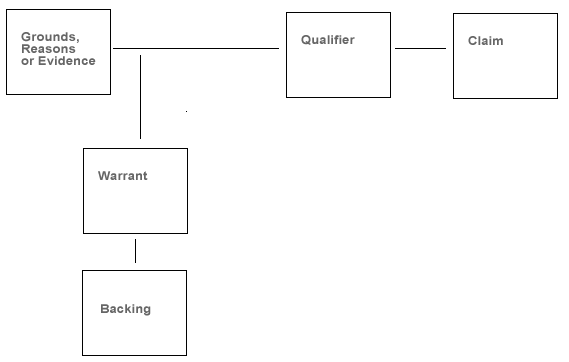
My favorite attempt to create this type of structure is the ToulminModel (developed by the British Philosophy Professor Stephen Toulmin) which proposes the existence of practical or substantial arguments (wonder why I like him?) that can be diagramed in the following manner:


In this model, the Claim is an assertion you are trying to prove, the Grounds consist of the information you bring to prove the claim and the Warrant supports your assertion that the Grounds should lead you to the Claim.

“What’s the big deal!” I hear you cry out.  Isn’t a “Claim” just a conclusion to a logical argument?  And aren’t “Grounds” just another way of describing your premises, with logic serving the role of the “Warrant” that links the two?

Actually, no, since Grounds in the case of a Toulmin argument might consist of facts (even axiomatic facts that logic requires everyone to agree to as the basis of any argument).  But they might be laws, regulations, social customers, literary references, or any other man-made (or even natural) “thing” that can provide support for the Claim. And the Warrant can make a logical connection, but it might also make an emotional or ethical appeal (all equally valid under Toulmin’s scheme).  And the fact that the Warrant requires Backing (a demonstration that the Warrant is sound and appropriate) adds an additional layer of rigor, even if this Warrant relies primarily on logic to link A (Grounds) to B (a Claim).

Toulmin also adds another nice feature: the Qualifier, that lets you present exceptions to your Claim. While qualifications can be implied in logical statements such as SOME As are NOT B, natural language cries out for us to specify which As we are talking about.  So the claim that “Freedom of speech is an unarguable good.” can be easily qualified as “Freedom of speech is an unarguable good, except in cases where it might lead to physical harm to someone else.” without diminishing the original point (or leaving us responding to an seemingly logical but actually illogical argument that “Since you don’t believe in free speech in all situations, you don’t really believe in free speech).”

Now Toulmin diagrams can get quite complex, especially once you realize that Grounds may be required to support a Warrant and that this means the Warrant can play a secondary role as another Claim (or Sub-Claim) that needs to be supported (with Grounds, Warrants and Backing) before it can be accepted and used to prove the ultimate Claim.

This might all sound a bit abstract, but as we’ll see once we start digging into actual political debates (i.e., arguments) Toulmin provides an important arrow in our quiver as we try think about the best way to think for ourselves during a Presidential election when many people would prefer that we not think at all.